


Introduction
One of the largest limitations of AI models current is that they are static once they are trained. Giving AI the ability to improve itself without training data would unlock enormous improvements in AI capabilities. As the R-Zero paper puts it:
Self-evolving Large Language Models (LLMs) offer a scalable path toward superintelligence by autonomously generating, refining, and learning from their own experiences.
The three papers below present various types of self-evolution of AI systems, by using iterative feedback loops combined with self-evaluations, i.e., LLM-as-a-judge, to guide AI improvement.
A Comprehensive Survey of Self-Evolving AI Agents. This survey paper on Self-Evolving AI Agents shows how self-evolution principles are applied to AI Agent systems, to enable such systems to continue to improve in real-world environments.
Test-Time Diffusion Deep Researcher (TTD-DR): The TTD-DR paper uses iterative refinement and self-evolution to improve deep research AI workflows.
R-Zero: Self-Evolving Reasoning LLM from Zero Data: The R-Zero paper shows a method for self-improving AI reasoning, with Challenger and Solver model refined models, to improve AI reasoning by improving both questions and answers in the training process.
A Survey of Self-Evolving AI Agents
The evolution from MOP (Model Offline Pretraining) to MASE (Multi-Agent Self-Evolving) represents a fundamental shift in the development of LLM-based systems, from static, manually configured architectures to adaptive, data-driven systems that can evolve in response to changing requirements and environments.
Existing AI agent designs remain fixed after training and deployment, limiting their ability to adapt to dynamic real-world environments. The paper A Comprehensive Survey of Self-Evolving AI Agents: A New Paradigm Bridging Foundation Models and Lifelong Agentic Systems examines self-evolving AI agents, an emerging paradigm that aims to imbue static foundation models with the continuous adaptability necessary for lifelong agentic systems.
This work formalizes self-evolving agents as autonomous systems capable of continuous self-optimization through environmental interaction, using the term MASE, Multi-Agent Self-Evolving systems, to describe such systems.
The paper proposes "Three Laws of Self-Evolving AI Agents” as guiding principles to ensure safe and effective self-improvement: Endure (safety adaptation), Excel (performance preservation), and Evolve (autonomous optimization). MASE systems are driven by the core goal of "adapting to changing tasks, contexts and resources while preserving safety and enhancing performance."
The conceptual framework for how self-evolving agentic systems work breaks the underlying feedback loop for AI system learning into four key components: System Inputs, Agent System, Environment, and Optimisers.

This framework underpins iterative refinement, where the AI agent system (single agent or multi-agent) processes inputs within an environment, generates feedback signals, and then utilizes optimizers—which define a search space and an algorithm—to update its components. These components include the core LLM's behavior, prompt strategies, memory mechanisms, tool integration, and in multi-agent settings, workflow topologies and communication protocols.
This survey categorizes and details existing optimization techniques across these components and highlights domain-specific strategies in areas like biomedicine, programming, and finance. They observe progress in shifting from manually configured systems towards automated learning and adaptation in AI agent architectures and behaviors.
While significant challenges remain in areas such as reward modeling stability, real-world evaluation, and managing efficiency-effectiveness trade-offs, the insights offered lay a foundational understanding for developing more robust and trustworthy adaptive AI agent systems.
Deep Researcher with Test-Time Diffusion
Our framework meticulously models the entire research report generation as an iterative diffusion process, mirroring human cognitive patterns. - Deep Researcher with Test-Time Diffusion.
The paper Deep Researcher with Test-Time Diffusion from Google Research introduces TTD-DR, a novel framework designed to improving LLM-powered deep research agents in generating complex, long-form reports. This system significantly outperforms existing deep research agents.
Existing agents often struggle with maintaining coherence and minimizing information loss during iterative search processes, lacking a principled, human-like iterative research paradigm. The TTD-DR addresses this by conceptualizing research report generation as a diffusion process, mirroring the human approach of iterative drafting, searching, reasoning, writing, and revision.
Crucially, the framework incorporates two synergistic mechanisms:
Report-Level Refinement via Denoising with Retrieval: After planning, TTD-DR generates a preliminary, updatable draft, which serves as an evolving foundation to guide the research direction. This draft undergoes iterative refinement through a "denoising" process, dynamically informed by a retrieval mechanism that incorporates external information at each step. This continuous feedback loop ensures the report remains coherent and the research stays on track, mitigating the context loss common in linear agentic workflows.
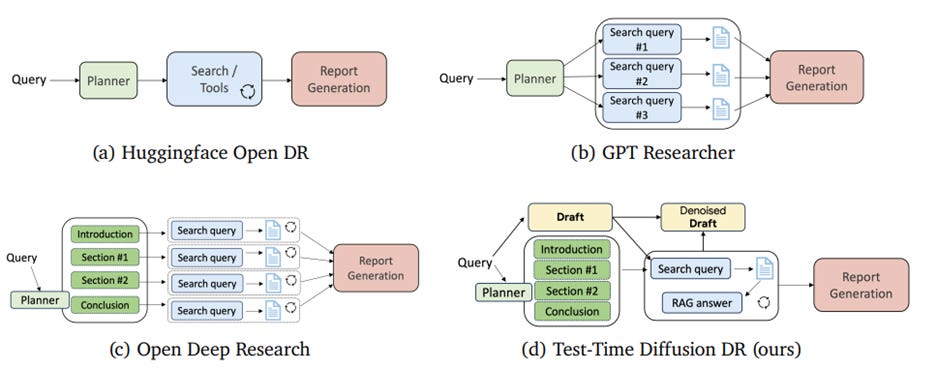
Component-wise Optimization via Self-Evolution: TTD-DR uses a self-evolutionary algorithm to enhance each component of the workflow - research plan generation, search question formulation, and answer synthesis. This involves generating multiple variants of outputs, assessing them using an LLM-as-a-judge, revising based on feedback, and merging the best elements. This interplay ensures high-quality context for the overall report diffusion.
TTD-DR demonstrates state-of-the-art performance across a wide array of benchmarks requiring intensive search and multi-hop reasoning. On long-form report generation tasks, it achieved win rates of 69.1% on LongForm Research and 74.5% on DeepConsult benchmarks in side-by-side comparisons against OpenAI Deep Research.
The TTD-DR process is a clever approach for deep research report generation, and a close analogy to human-based drafting. Such iterative, human-inspired frameworks with built-in iterative feedback have potential across many agentic tasks, so expect similar workflow self-evolution design patterns for other tasks.
R-Zero: Self-Evolving Reasoning LLM from Zero Data
The research paper from Tencent AI Lab R-Zero: Self-Evolving Reasoning LLM from Zero Data addresses a critical bottleneck in advancing AI systems beyond human intelligence: the scalability and cost of human data annotation for training self-evolving LLMs. The paper introduces a fully autonomous framework called R-Zero that enables LLMs to self-evolve their reasoning without reliance on human-curated tasks or labels.
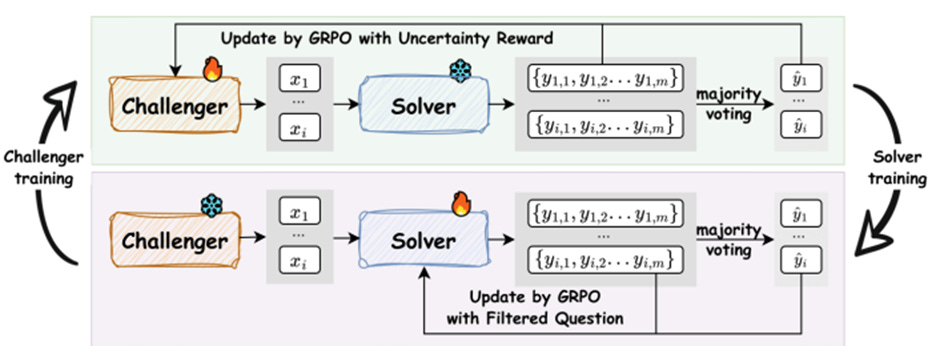
R-Zero's core contribution is a novel co-evolutionary loop between two independent models, a Challenger that asks questions and a Solver that answers them, to iteratively generate, solve, and learn from their own experiences:
The Challenger is rewarded for proposing tasks near the edge of the Solver capability, and the Solver is rewarded for solving increasingly challenging tasks posed by the Challenger. This process yields a targeted, self-improving curriculum without any pre-existing tasks and labels.
Both the Challenger and the Solver are fine-tuned via Group Relative Policy Optimization, GRPO. The Challenger reward function is designed to incentivize questions that maximize the Solver’s uncertainty, with a 50% chance of solving them. Similar to other systems for reasoning without verifiable-rewards, the Solver derives its labels for training through a majority-vote mechanism from its own multiple generated answers, eliminating the need for external verification or human labelling.
Empirically, R-Zero consistently and substantially improves the reasoning capabilities of tested AI reasoning models:
Zero substantially improves reasoning capability across different backbone LLMs, e.g., boosting the Qwen3-4B-Base by +6.49 on math reasoning benchmarks, and +7.54 on general-domain reasoning benchmarks (SuperGPQA).
One limitation is that as questions become more difficult, the accuracy of the self-generated pseudo-labels can decline, a potential limitation for ultimate performance. Future work could focus on more robust pseudo-labeling techniques and extending this paradigm to subjective open-ended generative tasks.
By alleviating reliance on human data and scaling self-improvement, R-Zero is not just scaling AI reasoning, but takes us closer to self-evolving AI models.