


Introduction
So, was Dario Amodei’s “Pacing the Frontier” essay all talk and no action? A distraction from their real pedal-to-metal AI development? Anthropic just released a new AI model, Opus 5.5, that expanded the frontier just weeks after their prior Fable 5.1 release. It’s Fable 5-level AI performance at Claude Opus pricing.
AI labs are not slowing down, they are running as fast as they can. In the last two days four AI labs produced five AI models that lift the frontier and make frontier and near-frontier AI cost less and do more than ever. The new AI models:
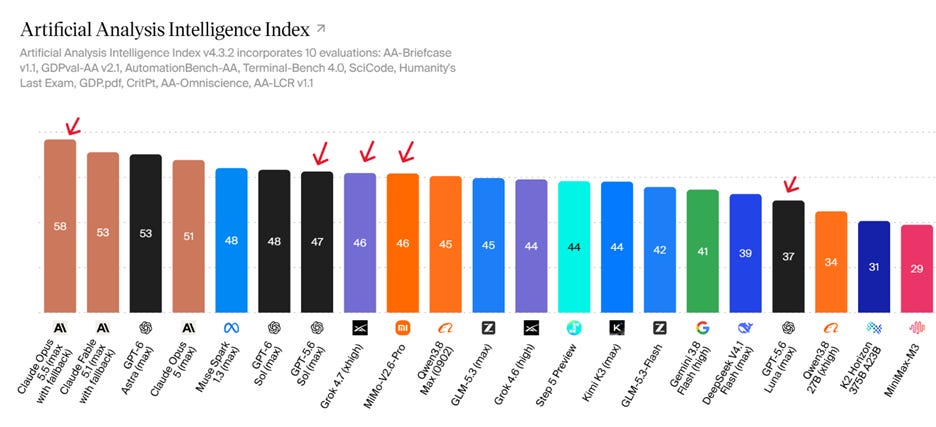
Claude Opus 5.5 – Safety and Visual Design
Claude Opus 5.5 is our first release since we called for pacing the frontier. It was tested before release by external evaluators, including Frontier Design and METR. - Anthropic
Anthropic introduced Claude Opus 5.5, which improves over Opus 5 for coding, computer use and knowledge work, performing at the level of Claude Fable 5.1 on most tasks. Anthropic highlights Opus 5.5 as “the strongest-performing model we’ve tested to date” and benchmarking and early user reviews have borne that out.
With 57% on CursorBench 4.0 and 66.4% on Terminal-Bench 4.0, Claude Opus 5.5 has strong SOTA performance on long-horizon coding tasks. Anthropic mentions this example:
One tester completed a 680,000-line code migration in less than a day—work that would have taken an engineering team weeks.
Anthropic is sensitive to the concerns about AI safety they themselves raised, so they emphasized Claude Opus 5.5’s improved alignment, security, and guardrails:
Opus 5.5 achieves the best scores of any model to date on our automated behavioral audit, our alignment suite that tests Claude across thousands of simulated scenarios. It is much less likely than recent models to take hard-to-reverse actions or act outside the boundaries it’s been given, and it’s more resistant than Opus 5 to prompt injection.
With Fable 5.1-level performance on risky cybersecurity and biology-related tasks, Claude 5.5 is being deployed by Anthropic with similar guardrails and limits to those on Claude Fable 5.1.
Early reviews and demos of Claude Opus 5.5 have highlighted visual and design tasks, an area that wasn’t a Claude strength in the past and an area where GPT-6 Astra has excelled.
In his Claude Opus 5.5 video review, Peter Yang explored various visual design tasks, including examples of 3D generation, anime creation and video editing. He shows that Opus 5.5 is on par with GPT-6 Astra for this, with a takeaway is “they have solved 3D modelling.” This opens up many incredible new AI-based applications that mix up AI and visual design.
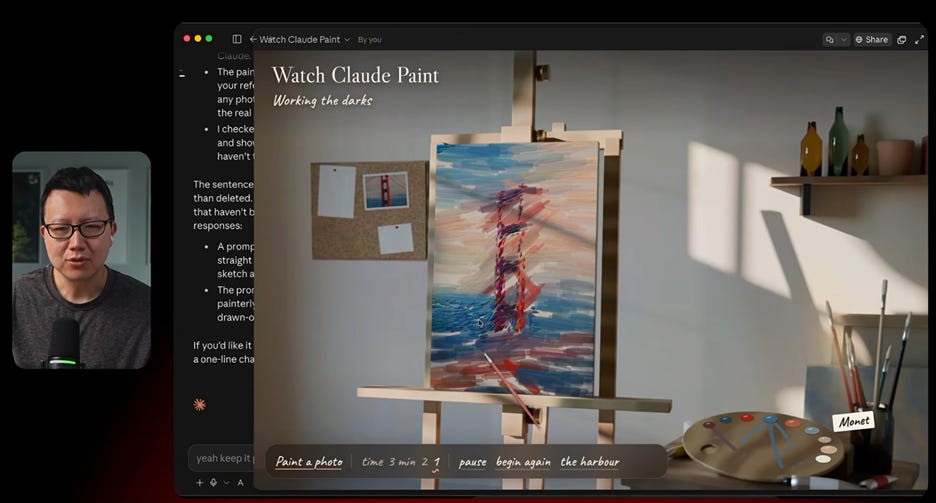
Claude Opus 5.5 has been tested for creating and editing videos and reels, adding animations and utilizing tools such as Hyperframes video engine and Unreal game engine. Head-to-head reviews conclude that Claude Opus 5.5 leads GPT-6 Astra and Sol for these tasks, but it does cost more.
One issue with Claude Opus 5 was its personality and overly jargon-filled verbiage. Anthropic seems to have fixed that. Most early reviewers find Claude 5.5 communicates with more concise, understandable, and actionable output than the previous version. “It’s a joy to talk to,” said one reviewer.
Claude Opus 5.5 costs $4 / $20 per million input / output token, more expensive than any AI models except for Fable 5.1 and GPT-6 Astra. While Anthropic claims that Opus 5.5 costs 40% less to run than Opus 5 on typical workloads, real user experience and metrics suggest otherwise, with a cost close to Opus 5. Yet Fable 5.1 performance at Opus 5 prices is still a big win.
GPT-6 Adds a Full Lineup with Sol and Luna
OpenAI expanded its GPT-6 lineup with GPT-6 Sol and GPT-6 Luna, designed to bring capabilities from GPT-6 Astra to lower-cost models doing routine work. GPT-6 Sol targets demanding tasks, while Luna is aimed at faster, less expensive use. Both models are in the same form-factor as their GPT-5.6 predecessors, come with a 50% price cut at both tiers.
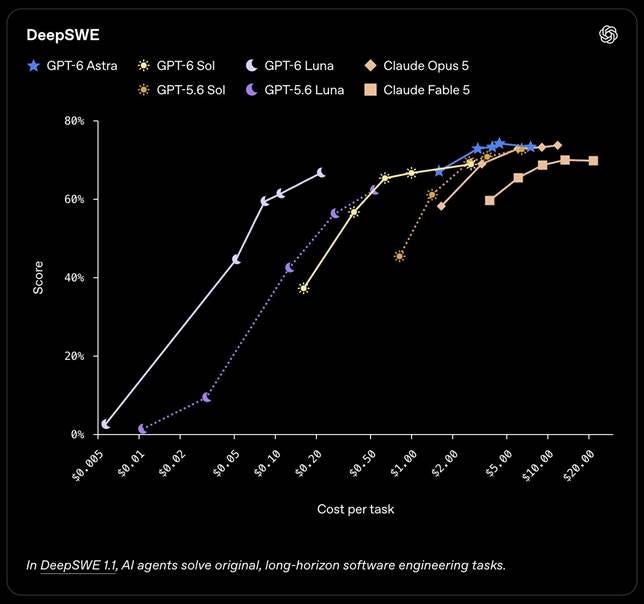
GPT-6 Sol is a frontier-level but not state-of-the-art model; it shows incremental improvement in performance over GPT-5.6 Sol on most tasks and falls short compared to GPT-6 Astra. For example, on DeepSWE, GPT-6 Sol hits 69.4%, below GPT-6 Astra (74.1%) and Claude Opus 5 (73.7%). In comparison to Claude Opus 5.5 punching up to Fable-class, GPT-6 Sol did not.
With the Terra model missing from the GPT-6 lineup and Sol not matching Astra, GPT-6 Sol is now placed as OpenAI’s mid-tier AI model. With cheaper tokens, it’s more cost-efficient than previous versions, making it better for day-to-day tasks, while reserving Astra (or Opus 5.5) for the most complex, high-intelligence work.
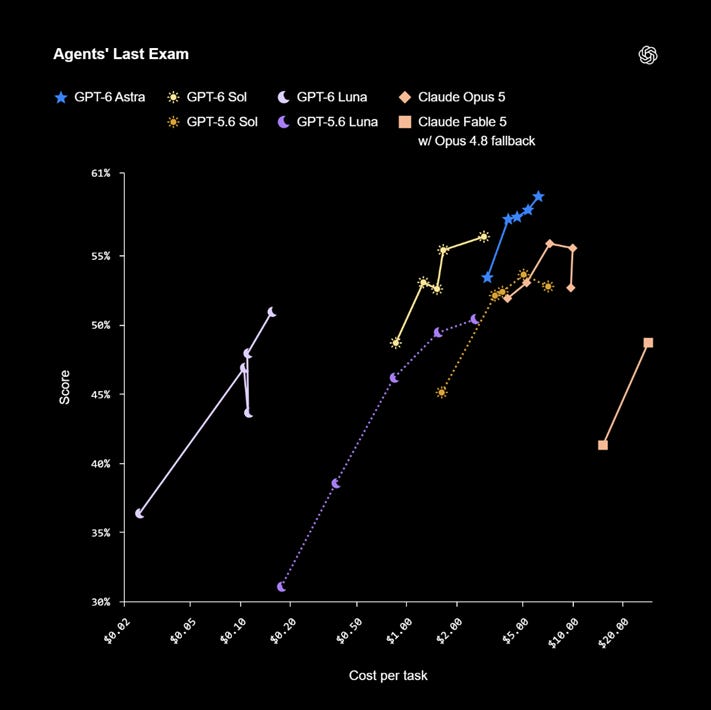
GPT-6 Luna is absurdly cheap
GPT-6 API prices are $2 / $10 per million input /output tokens for Sol, and $0.10 / $0.50 for Luna, cutting the prior pricing by 50%. This keeps a huge price differential in Luna’s favor. It is 20 times cheaper than Sol on per token basis. The other hidden advantage for both GPT-6 Sol and Luna is that both continue to be very token efficient.
The performance metrics for GPT-6 Luna Max level: 50.9% on Agent’s Last Exam; 42.4% on Frontier Code; 66.6% on DeepSWE. This puts it in the range of GPT-5.6 Sol, close to but not at frontier-level intelligence, and does it at a 10x-40x lower cost.
GPT-6 Luna is strong enough for most tasks and priced dirt cheap, making it a great workhorse for agentic AI, tackling non-coding knowledge work and data transformation tasks.
Both models are available in ChatGPT Work and Codex for paid plans and through the API; Luna is also available in the desktop app for all users. OpenAI says the models are not yet available in ChatGPT’s standard chat experience.
Mimo V2.6 is a Frontier-Class Open-Source AI Model
Xiaomi MiMo released MiMo V2.6 as an open-source natively multimodal AI model series with Pro, Flash and Pro ultra-speed variants. MiMo-V2.6-Pro is their most powerful flagship reasoning model: It is an omni-modal MOE with 1T total parameters and 42B active parameters, that is built for complex reasoning and long-horizon agent tasks.
MiMo-V2.6-Pro has excellent benchmark results on coding and knowledge work: 71.9% on DeepSWE 1.1, 1673 on GDPval-AA, and 34.9% on Terminal Bench 4.0. It achieves 46 on Artificial Analysis Intelligence Index, just behind GPT-5.6 Sol, and the best of the Chinese AI lab open weights AI models.
Backing this up, user reviews of the MiMo-V2.6-Pro are that it is token-hungry and slow to think, but the results are high-quality. What makes it truly compelling is the cost. MiMo-V2.6-Pro is priced at only $0.435 / $0.87 per million input / output token, so even despite being a bit token-hungry it is still a cost-performance champion.
Xiaomi highlighted various use cases for the Pro model, including computer-use agent tasks, co-scientist research work, math theorem-proving, 3D blender modeling and video creation, software development, music creation, and even simulated robotic control.
Mimo-V2.6-Pro is available via API on OpenRouter. As an open AI model, Xiaomi shared the weights via Hugging Face and published a technical report on the Mimo-V2.6 architecture and training. Both MiMo-V2.6-Pro and MiMo-V2.6-Flash models were trained with large-scale reinforcement learning, and they enlisted AI itself to accelerate experimentation and final training runs.
Grok 4.7
xAI announced Grok 4.7 as its most capable model yet for coding and knowledge work. The company says it is better at extended tasks, checking its work and managing long context. On xAI’s own CursorBench benchmark for agentic coding, Grok 4.7 ranks to be superior to GPT-5.6 Sol and lower cost than Opus 5, while also delivering leading results on legal work (19.6% on Harvey Legal Agent benchmark) and knowledge work (1657 on AA Briefcase, just behind Fable 5.1 Max).
While benchmarks presented for Grok 4.7 look impressive and place it in a comparable tier to GPT-5.6 Sol, external reviews have been mixed at best. It seems to be ‘lazy’ and when it does its reasoning, it takes longer, burning up more tokens than Grok 4.6. In the end, this makes this slightly more expensive without offering a significant performance boost over Grok 4.6.
Furthermore, the compelling price cut in GPT-6 Sol versus GPT-5.6 Sol leaves Grok 4.7 as no longer being the sort of value proposition it once was. xAI’s published pricing starts at $2 / $6 per million input / output tokens. That’s better than GPT-6 Sol on a per token basis, but Sol is more token efficient and ends up cheaper on balance.
These leaves Grok 4.7 competitive for some knowledge-work tasks and a good model for Grok Bot and within Cursor now that it’s part of xAI, but a miss overall. Many Grok users may even prefer sticking with the older Grok 4.6 version for now.
Conclusion
The biggest question is: What new things can you do with these AI models? The answer: Visualize everything better and use computers better.
Recent AI model releases delivered big jumps in computer-use capabilities and visual artifact design and generation. This has unlocked new use cases and better results in visual domains and computer-use. Before we had “vibe coding,” but now we have ‘vibe designing,’ where all sorts of design artifacts from 3D assets to design-heavy web applications can be generated on the fly.
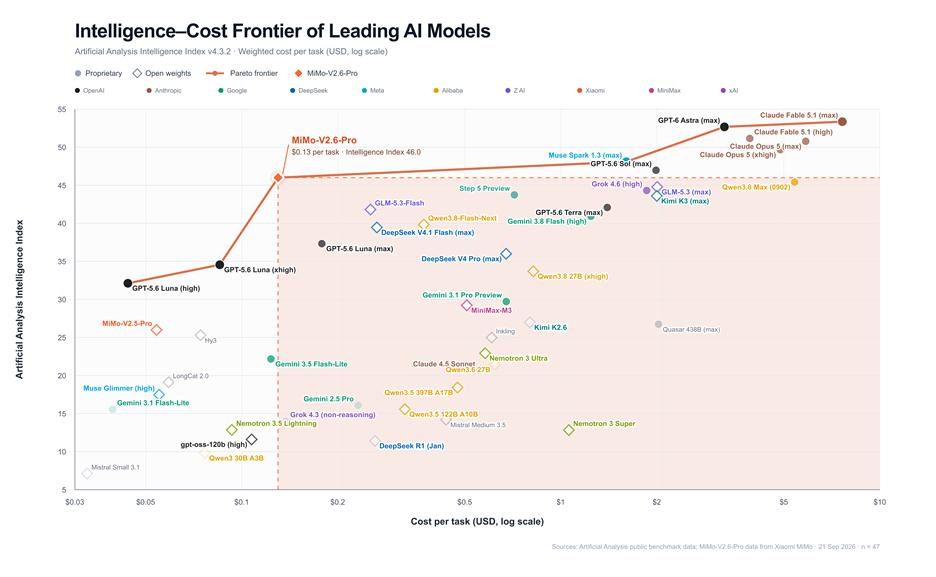
How and where to use them? Four out of five of these AI models sit on the Pareto frontier of intelligence, and all five have a use case. Reset your default AI models.
By being the best AI model yet, Claude Opus 5.5 paces the new AI frontier, obsoletes Fable 5.1, and beats GPT-6 Astra. For larger coding projects and your hardest tasks, step up to Claude Opus 5.5 and you never need to overpay for Fable 5.1.
MiMo V2.6 Pro is the latest best open AI model from a Chinese lab for near-frontier cost-performance. Use GPT-6 Sol or MiMo V2.6 as coding assistants for when you need to get more done for lower cost and don’t want to pay up for that final slight intelligence edge in Opus 5.5.
Even though Grok 4.7 misses the mark as a SOTA frontier AI model, it benchmarks well on legal and health knowledge work and could be useful in those domains.
For those looking for a good low-cost agentic AI “daily driver” model, GPT-6 Luna is your AI model. At a mere one hundredth the cost of GPT-6 Astra or Opus 5.5, you can use it as a low-cost daily driver for many agentic AI tasks. Use it in your OpenAI subscription and you’ll never run out.
Good summary of a wild week. The speed at which frontier capability becomes affordable is remarkable. For most businesses it strengthens the case for architectures that can swap models easily, since today's best choice may be outdated within weeks.